

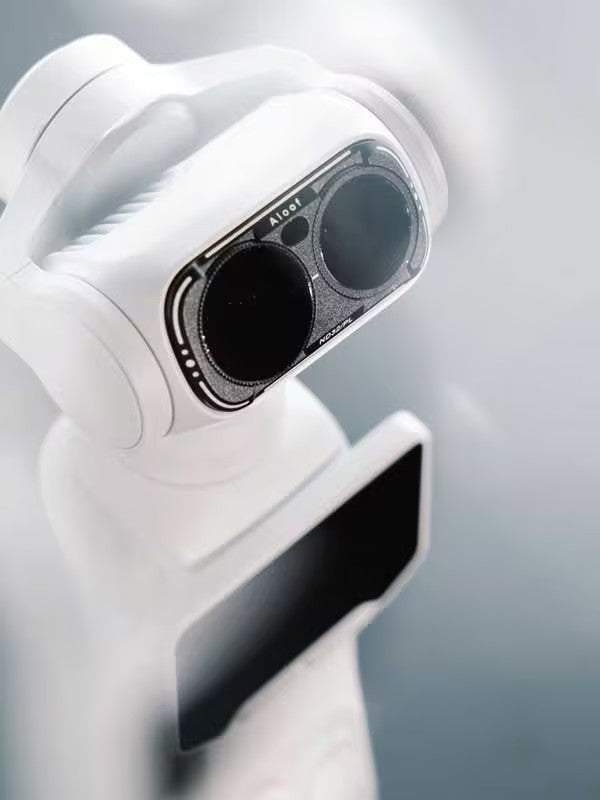
With the dawn of the compact-camera era, pocket cameras have become go-to tools for many people to capture everyday moments on the go.
From the first-generation DJI Osmo Pocket in 2018 to the DJI Osmo Pocket 4 in 2026, handheld cameras have undergone groundbreaking evolution. On June 10, 2026, Insta360 released its very first pocket camera — the Insta360 Luna Ultra.
If you haven't picked one up yet, you're probably stuck deciding between the DJI Osmo Pocket 4 and the Insta360 Luna Ultra. So today, I'll walk you through the key differences between these two products from every angle, using straightforward explanations. By the time you finish reading, I'm confident you'll have a clear answer.
Core Differences
Compared with the Osmo Pocket 4, the Luna Ultra takes a fundamentally different approach in terms of functionality. In fact, these two products can be seen as going down completely different paths.
Luna Ultra's Key Advantages
1. Telephoto Lens: Greater Creative Freedom
From the 1st to the 4th generation, the Pocket series has always used a fixed wideangle lens, with any "zoom" being purely digital — which inevitably degrades image quality. The Luna Ultra, however, features a dedicated 3× optical telephoto lens (with a 1/1.3″ sensor), enabling distant closeups, compressed perspective, and even macrolike shots from afar — effectively giving you a second lens.
2. Detachable Remote Control Screen with Image Transmission: More Convenient to Use
The screen can be detached from the body and used as a standalone remote control plus monitor, with image transmission up to 20 meters. Whether you place the camera on a tripod for a faraway selfie or clip it onto your backpack for follow shots, there's no need to pull out your phone and pair an app — just detach the screen and you have full control and live view at your fingertips. Quick and effortless.
3. 8K + Dolby Vision + Leica Color Science
The advantage here is that footage remains sharp even when cropped in, and delivers a cinematic look straight out of camera without the need for postprocessing. The Luna Ultra clearly has the edge in this regard.
4. Nighttime Processing Power That Crushes the Competition
A Qualcomm 4nm flagship chip paired with two independent professional imaging chips forms the Luna Ultra's triplecore AI architecture. In realworld tests, noise control and shadow detail are noticeably cleaner than the Pocket 4, especially under complex lighting like city neon signs.
Osmo Pocket 4's Core Strengths
1. Lighter Weight: Shed a Quarter of the Bulk, Slides Right Into Your Pocket
179 g vs. 233 g — those 45 grams might sound trivial on paper, but the difference in how it feels sitting in your pocket and the fatigue after long one-handed shooting sessions is genuinely noticeable.
2. Super Slow Motion at 4K/240fps
Against the Luna Ultra's 4K/120fps ceiling, the Pocket 4's 240fps lets you silky-smoothly slow down motion-heavy content — sports, pets darting around, kids bouncing and running — where every extra frame counts.
3. Ecosystem Maturity
Direct pairing with the DJI Mic 2 / Mic Mini (no receiver needed), the Mimo app's color preset and LUT library, Aloof magnetic filters, and a massive catalog of third-party accessories. The ecosystem is simply deeper and more battle-tested.


So — Now That We've Laid Out Both Sides, How Do You Choose?
Start by asking yourself a few questions:
What do you shoot most?
- Shooting subjects at a distance / portrait bokeh / cropping into landscape details → Insta360 Luna Ultra
- Action / extreme sports / need buttery 4K 240fps slow motion → DJI Osmo Pocket 4
What's your color preference?
- That Leica look → Luna Ultra (I-Log + ACES workflow)
- DJI pipeline → Pocket 4 (D-Log M + 13+ stops of dynamic range, and the ecosystem is rock-solid)
The Bottom Line
The Luna Ultra is Insta's statement piece — it cracks DJI's stranglehold by hammering three genuinely differentiated wedges: dual-camera versatility, optical telephoto, and that detachable remote screen. Its strengths aren't marketing fluff — the long focus and wireless screen combo deliver real, non-substitutable utility.
But the Pocket 4's advantage was never about winning a spec sheet arms race. It wins on handfeel, weight, and an ecosystem that's been refined over half a decade.
And hey — one last option worth noting: you could always wait and see what a DJI Osmo Pocket 4 Pro might bring to the table.
Share:
What does an ND(Neutral Density) filter do? ND filter guide for beginners.
The Latest 360 Cameras Are Here — Which One Is Your Favorite? Part One